The Black Mold
Assessments Process Health Effects Education FAQs Book consultation
Indoor Air Quality ·Now accepting consultations

Breathe with confidence,
not concern.

Professional indoor air quality assessment for homes where someone has asthma, allergies, chronic cough, or any reason to be cautious about what they’re breathing. Clinical-grade testing, calm guidance, results you can share with your physician.

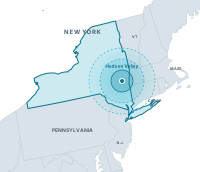
Hudson Valley, NY    Phone consultations are complimentary    Reports suitable for sharing with your physician

Standards & partnerships

EPA Mold Remediation Guide NYS Department of Health IICRC S520 ASTM Sampling AIHA-Accredited Labs
Who we help

For households where every breath matters.

If anyone in your home has a respiratory condition, an immune sensitivity, or simply a persistent feeling that the air is “off,” you deserve a clear answer — not guesswork.

Asthma Chronic allergies Post-COVID respiratory issues Persistent cough Chronic sinusitis Immunocompromised household Infants & young children Elderly family members Expectant mothers Mold sensitivity (CIRS) Recent water damage Musty odors Visible mold growth Unexplained fatigue or headaches

A note from Michael

When someone in the home is already managing a respiratory condition, the last thing they need is alarmism or upselling. My job is to give you a clear, factual picture of your air — what’s there, what isn’t, and what (if anything) we should do about it.

If we don’t find a problem, I’ll tell you that. If we do, you’ll have a written report you can share with your doctor, your insurer, or a remediation contractor.

Assessments

A structured workup, calibrated to your home.

Every service is grounded in EPA and NYS Department of Health protocols. Lab samples are processed by AIHA-accredited facilities.

Mold & moisture inspection

Comprehensive walkthrough with moisture meters, hygrometers, and thermal imaging to identify conducive conditions and visible concerns.

Air & surface sampling

Targeted sampling submitted to AIHA-accredited labs for spore identification, speciation, and concentration analysis.

Indoor air quality workup

Broader IAQ evaluation including airborne contaminants, allergens, ventilation, humidity, and environmental triggers.

Written remediation protocol

If remediation is warranted, you receive an itemized written protocol you can hand to any qualified contractor.

Post-remediation verification

Independent on-site verification of contractor workmanship and containment prior to clearance sampling.

Clearance & documentation

Final clearance sampling and a signed letter of completion — suitable for insurance, real estate, or your physician.

Our process

From first call to written report.

Calm, methodical, and paced for households managing real health concerns.

Step 01 Complimentary

Phone consultation

We talk through your concerns, symptoms in the home, and any known triggers. Often, a 15-minute call is all that’s needed to decide whether a visit is warranted.

Step 02 On-site

Assessment visit

A thorough, unhurried inspection. I walk through what I’m measuring as I go, so you understand each finding in real time — no mystery.

Step 03 Lab

Laboratory analysis

Samples are processed at AIHA-accredited laboratories. Turnaround is typically 3–5 business days for standard panels.

Step 04 Written

Findings & protocol

A written report with plain-language interpretation, lab results, photos, and (if needed) a remediation protocol. Followed by a debrief call to walk through everything.

Your first visit

What to expect, in order.

A typical on-site assessment takes 60–90 minutes. Here’s exactly how it unfolds — no surprises, nothing rushed.

  1. Arrival & introductions

    ~5 min

    I arrive in an unmarked vehicle with PPE and equipment in hand. We sit down briefly so you can walk me through your concerns, any symptoms you’ve noticed, and the history of the home — recent leaks, renovations, or weather events worth knowing about.

  2. Guided walkthrough

    ~15 min

    You lead me through the spaces of greatest concern first — whether that’s a bedroom, a finished basement, or a bathroom. I note visual signs, ask questions, and form a mental map of where moisture is most likely to be hiding.

  3. Environmental readings

    Instrumentation

    Calibrated moisture meters on suspected walls and floors, hygrometer for relative humidity, and thermal imaging to find cold spots and hidden wet areas without opening anything up. I explain each reading as I take it.

  4. Full-home inspection

    ~20 min

    Attic, crawl space, basement, mechanical rooms, behind appliances, around windows, under sinks. The places mold actually starts. Photos are taken throughout for the written report.

  5. Sampling (if warranted)

    Lab pickup

    Air samples with a calibrated spore-trap pump, surface samples by tape lift or swab where appropriate, and always an outdoor control sample for comparison. If sampling isn’t warranted — sometimes the cause is obvious — I’ll tell you that and save you the cost.

  6. On-the-spot debrief

    Before I leave

    We sit back down and I share preliminary findings: what I observed, what concerns me, what doesn’t, and what to expect from the lab if samples were collected. You leave the visit with a clear picture — not just a vague promise of a report later.

  7. Written report & follow-up

    3–5 business days

    A plain-language written report arrives by email with lab results, annotated photos, and clear recommendations. A follow-up call is included to walk through everything and answer questions — on your schedule, not mine.

Why this matters

Indoor air is not abstract — it’s clinical.

For people with respiratory conditions, the quality of indoor air can be the single largest environmental factor shaping daily wellbeing.

90%
of time the average American spends indoors — EPA
2–5×
indoor pollutant levels compared to outdoor air — EPA
48h
window for mold growth after moisture intrusion
100+
indoor mold species linked to respiratory effects
Complimentary phone consultation

Let’s talk through what you’re experiencing.

A 15-minute phone call to understand your concerns and decide together whether an on-site assessment is the right next step.

Reports are formatted to be shared with your physician, allergist, or pulmonologist on request.